|
 |

|
|
|
|
|
|
|
|
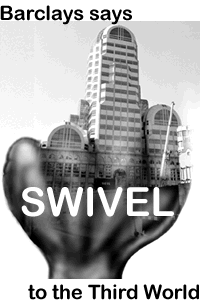
Who owns the companies? Companies are mostly owned by institutional investors - insurance companies, pension funds and investment companies. Institutional investors own over two thirds of shares in large British companies. They have 'portfolios' of investments in different shares, bonds and property. They generally invest other people's money - pensions, insurance contributions or private investments. According to one City fund manager, "The workers took ownership of capital twenty years ago, it's just that no one ever told them". Pensions were a victory of the socialist movements of the 19th century. Now they are central to capitalism. The workers however have no control over the capital. That's left to fund managers, who decide when to sell one company, or buy more of another. Most fund managers are legally bound to maximise profits, whatever the ecological or social cost. It's a gambler's dream. People give you their money, you gamble with it, give them a proportion of the takings, and keep the rest yourself. And if you lose: well, it's not your money, so it's not your problem. The institutions have immense power. Most don't go to company annual general meetings, but instead send proxy votes, and are granted private audiences with managers about what they should be doing. At Shell's 1997 AGM an ethical motion was presented, calling for external audit of company social and environmental policies. The debate in the AGM was largely irrelevant, as board chairman John Jennings had been given more than 50% of the votes by the biggest institutional shareholders, to use as he saw fit (ie. to defeat the motion). During the Thalidomide scandal of the early 1970's, the company in question - United Distillers - took no notice of shareholder protests until the big institutions saw their shares slipping and said 'Give them a settlement or we pull out'. Company directors often hold shares in the companies they work for. They are also given share options in their company, which means the right to buy a number of shares at a fraction of their market price (they can later be sold for a big profit). These both act as an incentive to keep company profits high. For example, in 1996 RTZ's chairman Robert Wilson exercised about 90,000 share options, buying them at about £5 and selling at about £10, so he made £450,000 out of this. In March 1997 he had over £600,000-worth of company shares. All this is on top of his salary of £575,000, bonus of £238,000 and other incentives of £350,000. Directors' holdings however make up a tiny portion of a company (well below 1% of its shares, between all the directors), except in special cases such as private Ltd companies (see Investments: Companies), or old family firms which have been floated. CAPTION: Barclays says SWIVEL to the Third World In fact, most of the big institutional investment companies run lots of different forms of investment scheme, providing insurance, pensions, investment trust and unit trusts within the same company. Insurance and Life Assurance CompaniesPeople pay regular premiums either for a lump sum in the future (life assurance) or for cover in the event of accidents, death, damage to property, etc (insurers). As people have more and more property to insure, insurance companies are building up more and more cash to invest. The 3 biggest insurers in the UK are CGU, Allied Zurich and Royal & Sun Alliance. The UK's biggest life assurance company is the Prudential. Pick just about any ethically-challenged corporation, and you'll find the Pru is a major shareholder. It holds 3.5% of Shell, 4% of Rio Tinto, 3% of Lloyd's TSB, 4.8% of HSBC, 3% of Mersey Docks and Harbour Company, 5% of Unilever, 3.8% of BAA, 3.4% of Tesco etc... Pension FundsMost working people contribute to a pension fund, through work or a private scheme. These investments are generally looked after by fund managers, like Mercury Asset Management or Schroder Investment Management. In 1998, USS, the pension fund for university lecturers and staff, held shares in Shell (£234 million), BP (£227m), tobacco company BAT (£112m), gene manipulators Zeneca (£95m), HSBC (£152m) and Rio Tinto (£75m). People & Planet, (a student movement) is campaigning to make USS use it's financial clout for ethical ends. Unit TrustsPeople put money into a collective investment fund and receive 'units' in return. This accumulated fund is then invested and people buy or sell units. The value of a unit goes up or down with the value of the investments. The money is held by a Trustee (e.g. a bank or an insurance company), and the rules of fund management are laid out in a Trust Deed. There are over 1000 trusts in the UK managed by around 200 companies. Unit Trust Advisory Services monitor them, and will give you detailed reports on their investments. The first report is free. Investment Trusts These are similar to unit trusts, but are registered as companies and floated on the Stock Exchange. You buy shares in the company, not units. The value of the shares rises or falls with the value of its holdings. The top investment trusts in the UK are 3i Group, Foreign & Colonial and Scottish Mortgage & Trust. Other FundsOther large investors include churches, local authorities health authorities, universities, trade unions and charitable trusts. It's rarely openly stated where the funds invest. Workers could easily be fighting pay cuts and layoffs, while their own union's fund managers push behind the scenes for the company to maximise profits by cutting wages and workers!
 Several supposedly 'clean' institutions have huge shares in UK arms companies, such as: health organisations with over £19m, charities with over £70m, local authorities in for £754m and religious bodies with £34m. Ethical Investments? Most investment companies also run ethical investment funds designed to lure the individual punter who is unhappy with particular sectors of the system, such as arms, tobacco, or animal experimentation, but still keen to make a profitable investment. There is over £1bn now invested in this area. However, it's kind of like buying a veggie burger in McDonald's, and the role of ethical funds is limited. For example, you'd be unlikely to find a fund which didn't invest in oil or mining. So you can't withdraw from investing in a way of doing business, nor from any of the less popular 'causes', such as exploitative food or commodities companies. There are some funds which only deal in smaller companies, but don't have any ethical criteria. A recent development is the introduction of funds which only deal in specifically positive projects (such as ecological building, radical cooperatives, or environmental projects), rather than trying to avoid the negative. These are about as ethical as investment gets, but are tiny, even compared to the mainstream "ethical". You won't find these in the City of London. Providing financial services for companiesBankers, advisors, brokers, lawyers, accountants. Major companies have their own financial staff - including lawyers, accountants, brokers etc - but they get advice, consultancy and project management from the many specialist service companies in the City who offer expertise in their field. You often see their names as sponsors of upmarket cultural events, such as Ernst & Young's support for the recent Monet exhibition in London. The motivation for this is not philanthropy, but rather to gain access to the "C-suite": the chief executives, chief financial officers and chief information officers of the world's top companies. It's all down to how you're seen by the corporate world, and getting your name on the poster underneath the right painter or conductor can make all the difference. Every company has bankers, who provide the similar services that banks provide for individuals: holding accounts, paying cheques, providing loans and overdrafts etc. These are generally high street banks (Lloyds, NatWest etc - see High Street Banks), but some are investment banks (such as Chase Manhattan, Kleinwort Benson) Financial advisors provide advice on the markets and share movements, on issuing new shares, and on mergers and take-overs (which is where the big money is). It is mostly investment banks who fulfil this role (such as Kleinwort Benson or Lazard Bros), but the accountants (eg PwC) are now joining in. A company's brokers invest its surplus cash in shares, and will advise on the company's and its competitors' share movements. When one company wants to take over another, its brokers can give it a head-start by surreptitiously buying up some of the target's shares. They also help get a better price by massaging up the company's share price, and massaging down the target's (by buying and selling shares). These may be specialist brokers such as Cazenove, or investment banks like SBC Warburg Dillon Read. There are over 2,000 legal firms in the City that deal with company and financial law, advising on share dealings, mergers and takeovers, and financial regulations etc. The big ones include Allen & Overy, Clifford Chance, Freshfields, Linklaters & Paines, Slaughter & May and Wilde Sapte. Another key role is played by accountants - Price-waterhouseCoopers, Ernst & Young, KPMG etc. They provide advice on financial control of a company's accounts. Their role is becoming much broader. They work as management consultants, and general financial advisors. The top ten investment banks worldwide are: Goldman Sachs, Morgan Stanley Dean Witter, Merrill Lynch, Saloman Smith Barney, Credit Suisse First Boston, Warburg Dillon Read, Deutsche Bank, JP Morgan, Chase Manhattan and Lehman Brothers.
The corporatisation of information. These two arch-rivals are immersed in 'the business of information', as Reuters' ad byline goes. In total, the City spent £2.2 bn on information technology in 1996. The provision of split-second market, business and general news is an intimate part of the globalisation process, where information really is power. Bloomberg is run by billionaire media mogul Michael Bloomberg, who was described recently by Sunday Business as "the Colonel Sanders of financial information services". In the City, his company offers a computerised service for about £2000 per month, covering every aspect of commerce and beyond. A trader or fund manager can key in an area in which they have an interest, and the information appears on screen in moments. Any interruption to either of these services could seriously impair the smooth running of the City. What's an investment bank?(aka merchant bank) They're the middle-men between companies and the institutions which own them. They deal with all aspects of financial services.
Different investment banks put more emphasis on different roles. For example, Goldman Sachs, Schroders and Rothschild, are big on advice. Credit Suisse First Boston focuses more on broking. Hoare Govett is the broking arm of ABN Amro, and works for British Aerospace, Rio Tinto and British Energy, amongst others. AnalystsAnalysts advise investors on whether to buy or sell a company. Analysts play one of the most important roles in the City . They advise investors on whether to buy or sell a company, based on a detailed assessment of it. Fund managers will shift vast blocks of cash into or out of a company on their say so. So companies are keen to keep a good relationship with theirs, and will invite them to presentations all over the world where they will explain their strategy, (naturally providing five star bed and board into the bargain). Malaysian leader Mahathir Mohammed travelled to the City in 1997 specifically to address a meeting of analysts about Ekran, the company previously embroiled in the destructive Bakun Dam project. Analysts work for brokers' companies, and make their money as a percentage of share turnover. They tend to specialise in 6 or 7 companies, in an industrial sector like telecoms or defence, or in a small number of very large companies, about whom they compile extremely detailed quarterly reports. They base their analysis of a company on contracts, market position, the viability of its strategy, the quality of its management etc. Often the analysts know more about a company than its directors! While that assessment would pay no heed to social or environmental implications, it could potentially be swayed by a powerful and well-argued campaign being waged against acompany or an issue, eg. genetic engineering or rainforest destruction, as any damage to a company's carefully greenwashed reputation can easily mean a low blow to the share price. Ratings agencies advise investors on how reliable an investment will be. Rating Agencies exist to give investors some idea of how reliable an investment will be. The two most famous and influential agencies are Moody's and Standard & Poor's. These are both American but with substantial bases in the City. There are also agencies which specialise in particular industrial sectors, or types of countries. When a company or a government makes an issue to raise finance, investors will pay a ratings agency to rate the issue. Standard & Poor's ratings range from AAA (very sound) to D (do not touch). Only issues rated BBB and above are considered sound enough for banks to invest in. The criteria for rating countries' governments are based on political risk, the agency making an assessment of the country's underlying social and political stability. Standard & Poor's Credit Week describes the most important factors as "The degree of political participation, the orderliness of successions in government, the extent of governmental control and the responsiveness of the system...Signals of high political risk include such events as periodic social disorder and rioting, military coups or radical ideological shifts in government." They also make an economic analysis by comparing a country's debt to its spending. Standard of living is also considered; the higher it is, the more governments can cut back if need be. What this means is that Third World Countries, particularly those with left-wing governments, are rated as being much more risky than Western 'democracies'. Agencies have the power to alter a country's rating, with potentially devastating implications on its economy, putting millions out of work.
Work
[FT Weekend, 21/11/98.] Pay There are over a quarter of a million people employed in the City, with average earnings of £750 per week (£39,000 p/a). Of that, nearly £70 per week is bonus, as a reward for personal performance or company profit. By contrast, the average national weekly earnings are £385 a week.
The group chief executive of Standard Chartered Bank earns £455,000 annual salary, plus £685,000 bonus. A senior partner at merchant bank Goldman Sachs earns £125,000 salary and between £1 million and £1.9 m bonus. A junior foreign exchange trader at Chase Manhattan earns £30,000, plus a bonus of about £130,000. [Evening Standard magazine, 15/1/99.] Meanwhile, the City has the lowest wage levels for office ancillary staff, (cleaners, temps etc.) of any comparable European financial centre. (From Post-Imperialism & the Internationalisation of London, Anthony King, Routledge 1991).
|
|
Always handy (maybe): WHAT'S THIS? INTRODUCTION CONTENTS
In this section:
WORK AND PAY IN THE CITY

Commercial and General Union Building |
||||||||
|
<< Top [ pdf's: booklet - map ][ j18 homepage ] |
|||||||||||