
 |
|
|
From Port to plate |
|||||||
|
January 2000
|
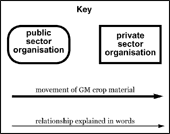
GM crop material arrives in the UK in many different forms. It might be as an unprocessed soya bean - but more often it will be processed and arrive as oil, meal for use in animal feed, as an ingredient in processed food, or even as meat and dairy products from animals reared on a GM diet overseas. This final flowchart shows how these products get from the port of entry in the UK to their ultimate destination - the consumer. Go to Glossary |
 |
Notes GM agricultural produce from North America is shipped to a port in mainland Europe, most commonly Rotterdam, where it is processed by ingredients processors for use in either processed food for humans or for animal feed. It is then often transported by barge to ports in the UK such as Tilbury and Liverpool. Often the export and import companies are the same, and may own the shipping company too. |
| Glossary |
|
| ACNFP - Advisory Committee on Novel Foods and Processes quango responsible for advising the UK government, mainly maff and Department of Health, on the safety of GM and other 'novel' foods on human health. ACNFP also provides the UK assessment body for all novel food and novel process applications submitted under EC regulations. It will report to the food standards agency (FSA) when it is established. The committee has 15 members - 13 scientific/medical experts, 1 consumer representative, 1 ethicist www.maff.gov.uk/food/foodnov.htm |
|
| Animal feed manufacturer Manufactures animal feed from raw and processed material, much of which is GM. Most GM crop material imported into the UK is used by these companies. Largest in UK are BOCM Pauls, ABN and Dalgety. See Corporate Watch briefings, back page. www.corporatewatch.org/genetics/gm.html |
|
| Broker Buys and sells bulk quantities of harvested agricultural commodity - sometimes on the spot market (buying it now) and sometimes as futures. Brokers are employed both by companies which handle large quantities of the produce (such as import / export companies on the one side, and eg processors on the other), and by companies with a purely financial interest (merchant banks / speculators). Some are based in exchanges and some at their companies. Ships' cargos may be bought and sold while the ships are still crossing the ocean, or even before they leave port, and may change hands several times. www.corporatewatch.org/squaringup/section3.html#top |
|
| Customs Documents and regulates imports; enforces import restrictions; collects import duties. www.hmce.gov.uk/bus/info/books.htm#Customs notices |
|
| Farmer Rears livestock on animal feed containing GM material. Meat farming has felt the crisis in British agriculture especially hard, due to BSE crisis. |
|
| Farmer Controlled Business Often co-operatives, these businesses exist primarily to serve the interests of member farmers. This usually means either supplying farm inputs or marketing members' produce. Examples: United Dairy Farmers, Midland Shires Farmers. |
|
| Import / export company. Transports raw and processed materials from country of origin, often in the case of GM products the US, to an importing country. They have large ELEVATORS and other facilities at docks such as Liverpool and Tilbury. The large agribusiness giants typical of this type of company often also own companies further up and down the supply chain. The world's 2 largest players are Cargill and Archer Daniels Midland (ADM). Cargill owns companies at every stage of the supply chain from SEED COMPANY to PROCESSED FOOD MANUFACTURERs such as Sun Valley, which supplies chicken to McDonalds. Their main business however is the movement of food from the farm where a GM crop is grown, through the ELEVATOR and INGREDIENT PROCESSOR to ANIMAL FEED MANUFACTURERS and PROCESSED FOOD MANUFACTURER. Company stores grain / processed GM material at docks in silos before loading them onto ships for export. Transports processed GM material (oil, cake, flour etc.) on barges / coasters to the UK. |
|
| Ingredients processor (See page 4). |
|
| MAFF - Ministry of Agriculture, Fisheries and Food No-one regulates import of GMOs into the UK - regulation is supposed to operate at the next level down the supply chain. Here, in theory MAFF regulates, but the prospect of inspecting the genetic make-up of bulk ingredients in a processing factory seems rather unlikely! |
|
| Port authority As well as customs, ships have to register their cargos for import or export with the port authority, and also their sailing times, destinations etc. |
|
| Processed Food Manufacturer Make brand and / or supermarket own-brand processed foods. Most large processed food companies are pro-biotech but have been forced to 'eliminate where possible' GM ingredients in many European countries for fear of losing market share. However, they will re-introduce them as soon as they feel they can. Examples: Nestle, Northern Foods, Unilever. |
|
| Retailer Sells products to consumers. The big superstores now have their own distribution networks, including a small number of regional distribution centres around the country, and a fleet of trucks. Often there is no need for a wholesaler. They also produce own-brand products, usually receiving processed products and just adding packaging. Since spring 1999, the big supermarkets have removed GM foods from their own brands. The Big Four are Tesco, Sainsbury, Asda and Safeway. Back l Next page |
|
| Corporate Watch is a research and publishing group whose aim is to support activism against large corporations. Copies of these briefings can be obtained by sending an A4 SAE (45p postage) to: Corporate Watch 16b Cherwell Road, Oxford OX4 1BG Tel/Fax +44 (0)1865 791391 mail@corporatewatch.org |
