
 |
|
|
Research, Development & Comercialisation |
|||||||
|
January 2000
|
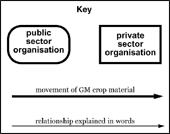
The first flowchart illustrates the companies and organisations involved in the research and development of GM crops in the UK, and the mechanisms that are being used to commercialise these products. However, it's worth pointing out that no crops currently being grown in the UK actually end up on people's dinner plates. They are either: · being developed in universities or at research centres; · being grown in National Seed List trials, part of the regulatory process on the way to commercialisation; or · being grown in the government’s controversial farm-scale trials. Go to Glossary |
 |
Notes Life Sciences companies often own the seed companies. Glossary ACGM - Advisory Committee on Genetic Modification A quango which advises the Health and Safety Executive and ministers on all aspects of the human and environmental safety of the contained use of GMOs - ie in the laboratory and industrial installations. It is not involved in product approval. The committee has 12 Members - 4 nominated by the TUC (Trades Union Congress), 2 by the CBI (Confederation of British Industry), 1 by Research Councils, 1 by Committee of Vice Chancellors and Principles. 3 independent experts, 1 lay member. www.environment.detr.gov.uk/acre/acgm.htm |
| ACRE - Advisory Committee for Releases to the Environment A QUANGO responsible for advising the government, mainly the DETR, on the environmental and human health impacts of releasing GM crops into the environment. There was a furore last year over committee members being too closely linked to industry, after which 12 members were replaced. The committee now consists of 11 scientific experts, 1 medical expert and 1 interest group (Green Alliance), although there are questions about industrial connections of the scientists. www.environment.detr.gov.uk/acre/index.htm |
|
| Analyst Analysts specialise in predicting the financial prospects of particular companies and industries. Their advice is sought by INVESTORS who buy or sell shares in a company. They often work for a merchant bank. For example, in August 1999 an analyst with Deutsche Bank, the largest bank in Europe, suggested that investors sell their shares in Monsanto and other LIFE SCIENCES COMPANIES. This in turn contributed to the decline in the companies’ prospects. www.corporatewatch.org/squaringup/section2.html#analysts |
|
| DETR - Department of Environment, Transport and the Regions UK Government department. Its Biotechnology Unit has responsibility for policy and operation of the legislation controlling the release of GMOs, and provides the secretariat for ACRE, which advises DETR. Government department most involved in the FARM SCALE TRIALS. Ultimately responsible for assessing the environmental consequences of planting GM crops in the open. www.detr.gov.uk |
|
| DTI - Department of Trade and Industry The UK government department responsible for promoting and supporting industry. Its Biotechnology Directorate is "charged with championing the industry case in all aspects of Government, European and international policies". It encourages further investment in biotechnology, provides grants to help companies apply biotechnology to their products and processes, and helps companies express their views to regulators in other government departments. DTI oversees the RESEARCH COUNCILS and the PATENT OFFICE, and sends the UK's delegations to the WTO negotiations. www.dti.gov.uk/bioguide/dti.htm#role |
|
| Farm scale trials Trials run by the government (mainly DETR) and SCIMAC, supposedly to assess the environmental impact of herbicide tolerant crops. They have been criticised for presenting an environmental threat themselves, and for providing inadequate information. Many feel their real aim is to help companies advance quicker towards commercialisation. Ecological monitoring is done by a research consortium. www.environment.detr.gov.uk/fse/index.htm www.foe.co.uk/camps/foodbio/brief/farmscle.htm |
|
| Farmer Grows the trial crop on his land. With increasing pressure and risks from protesters, media, and now supermarkets, few farmers are still willing to grow GM trial crops. Some trial sites are owned by other organisations - such as companies, Scottish Agricultural College and NIAB. |
|
| HSE - Health and Safety Executive. QUANGO sponsored by DETR. Responsible for all aspects of health and safety in the work place |
|
| Investor Buys shares in LIFE SCIENCES COMPANY and receives a dividend (if the company is profitable) each year. The largest investors are companies, often pension or insurance companies. eg Aventis’ major investors include Kuwait Petroleum Corporation, Bank of Ireland, AGF Insurance. www.corporatewatch.org/squaringup/section1.html#shares |
|
| Life sciences company Life sciences companies are the driving force behind genetic engineering. They invest in research and development of crop varieties, and they subsequently own the patented varieties and technologies. They carry out research in their own facilities as well as in universities. In many cases new crop varieties have been engineered for resistance to the life sciences company’s own proprietary herbicide - so that crop and chemical come together as a package. |
|
| MAFF - Ministry of Agriculture, Fisheries and Food (See also page 5). UK government department responsible for agriculture and subsequent links in the supply chain of food. Responsible for the NATIONAL SEED LIST TRIALS. www.maff.gov.uk/food/foodnov.htm |
|
| National Seed List trials Apart from certain exceptions all agricultural seeds species must be included on the National List or the EC Common Catalogue before seed can be sold in the UK and European Community. Once a valid application for National Listing is accepted, seed of the variety will be requested for tests and trials designed to assess whether the variety is distinct, uniform and stable (DUS) and, in the case of agricultural crops, whether it has value for cultivation and use (VCU). It is these trials that account for most of the deliberate releases of GM crops in the UK. They are carried out either by MAFF or The British Society of Plant Breeders. There are also quality tests, which are usually carried out by NIAB. The duration of both types of trial is, in most cases, a minimum of two years. To carry out a trial, GM seed applicants must have deliberate release consent from DETR, unless a full marketing consent has been issued by another EU Member State. www.maff.gov.uk/farm/pvs/nlguide.htm |
|
| NIAB - National Institute of Agricultural Botany Independent charitable body specialising in plant research, especially testing the performance of new seed varieties. Does research for the NATIONAL SEED LIST TRIALS as well as for LIFE SCIENCES and SEED COMPANIES. www.niab.com |
|
| Patent Office Involved with domestic and international policy and legislation on all forms of intellectual property. www.patent.gov.uk |
|
| Quango - (aka non-departmental public body) An organisation set up by government, but not technically part of it. Each quango has a government department which oversees it (eg ACRE reports to DETR), but has its own management structure, its own budget, and often its own offices. There are over 800 quangos in the UK, falling into 4 types: executive bodies (eg Environment Agency, Health & Safety Executive), advisory bodies (eg Advisory Committee on Novel Foods & Processes), public corporations (eg BBC, BNFL) and tribunals (eg Industrial Tribunals). www.cabinet-office.gov.uk/quango |
|
| Scientific suppliers Supply laboratories with chemicals, biological organisms, testing equipment etc. (To find lists, try looking through UK web search engines, using company classifications - eg ">http://uk.dir.yahoo.com/Business_and_Economy/Companies/ Scientific/Biology/Biotechnology/ |
|
| Research consortium Conducts the ecological monitoring of the Farm Scale Trials. Led by the Institute of Terrestrial Ecology and including the Institute of Arable Crop Research and the Scottish Crop Research Institute. |
|
| Research council The 7 research councils are the primary government source of research funding for universities. Since 1993 they have increasingly insisted on industrial applicability of the research they fund, and many schemes (eg LINK, ROPA) require industry match funding for research. The most important for GM research is BBSRC, the Biotechnology and Biological Sciences Research Council. www.bbsrc.ac.uk |
|
| SCIMAC - Supply Chain Initiative on Modified Agricultural Crops Industry organisation "established in June 1998 to support the responsible and effective introduction of GM crops in the UK." Runs FARM-SCALE TRIALS, along with DETR. Members: British Society of Plant Breeders (BSPB), British Agrochemicals Association (BAA), National Farmers Union, United Kingdom Agricultural Supply Trade Association (UKASTA) and British Sugar Beet Seed Producers Association (BSBSPA). |
|
| Seed company (See also page 4). Conducts seed trials, either for itself or under contract to life sciences company. |
|
| Trade association Non-profit membership organisation for companies in a particular sector. It's aims are to advance the interests of it's members through lobbying governments, supplying business information, doing industry public relations and promotion, networking, training etc. Examples are: EuropaBio www.europa-bio.be , Bio www.bio.org (American), UKASTA www.ukasta.org.uk , BSBSPA, BSPB, BAA www.baa.org.uk Grain and Feed Trade Association (GAFTA) www.gafta.com . |
|
| Universities Much research into GM technologies goes on in universities. The government over the last few years has given universities no choice but to work for business, by cutting public funding and by making research grants dependent on industry match-funding (see RESEARCH COUNCILS). The level of GM research is enormous, because it has such potential paybacks. More speculative research is funded by the taxpayer, while closer-to-market work is carried out under contract to companies. Back l Next page |
|
| Corporate Watch is a research and publishing group whose aim is to support activism against large corporations. Copies of these briefings can be obtained by sending an A4 SAE (45p postage) to: Corporate Watch 16b Cherwell Road, Oxford OX4 1BG Tel/Fax +44 (0)1865 791391 mail@corporatewatch.org |
