|
Newsletter Issue 3 May - June 2001 |
||||||||
|
UN-Corporated This month, Corporate Watch has had representatives zipping off to conferences in Estonia and Sweden. Both focused on the so-called Rio+10 summit: the UN World Summit on Sustainable Development, due to take place in Johannesburg in September 2002, ten years on from the Rio Earth Summit. The Johannesburg meeting is intended to focus on reviewing the progress (if any) made in implementing the Rio agreements; it will also look at the implications of new technologies, and at the role played by the international financial institutions and financial markets. What was Rio? Overtly the 1992 Rio Earth Summit was a well-intentioned attempt to achieve ‘sustainable development’: linking environmental crises with the need to redress the wealth imbalance between the industrialised north and non-industrialised south. Five major agreements were reached which were supposed to map out the path to a sustainable future: the Climate Change Convention, the Forest Principles, the Convention on Biodiversity, the Rio Declaration and Agenda 21. 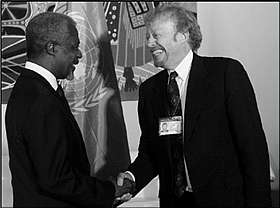 Kofi Annan demonstrates his electric shock buzzer on Nike CEO Phil Knight... The reality of Rio was very different from these utopian ideals. Alarm bells should have rung as soon as the Secretary General was appointed. He was Maurice Strong, a multi-millionaire Canadian businessman whose interests included oil and mining and who argued, at the preparatory conference in New York, that the Rio meeting should aim to be compatible with the General Agreement on Tariffs and Trade (GATT, forerunner of the WTO). The outcome of the Rio conference bore out everyone's worst fears - each of the five agreements was heavily influenced by pro-free-trade ideology, courtesy of Northern governments, particularly the US, and the industry lobby groups. The US was able to hold the world to ransom by refusing to sign the Convention on Biodiversity (aimed at preserving genetic resources and giving some protection to indigenous people's knowledge) and by insisting that the climate change convention contain no specific targets for the reduction of emissions. Slightly more subtly, industry lobby groups such as the Business Council for Sustainable Development and the International Chamber of Commerce were able to ensure that the final agreements were mere watered-down parodies of their original intent. Lobbying by the ICC ensured that Agenda 21 contained no reference to controlling transnationals or enforcing environmental cost accounting. Any legally binding legislation that might have hindered the activities of transnational corporations was replaced with seemingly altruistic voluntary agreements and promises of self-regulation. Perhaps the most worrying outcome of the Rio summit was the ease with which TNCs and northern governments were able to co-opt the language of environmentalism. A green commentator later wrote: It [the Rio Earth Summit] was a stupendous waste of time and money, a 'long flatulence', a sprawling day-care centre for environmental wanna-bes, the occasion for the 'highest level international policy centred mumbo-jumbo you can imagine', a defining moment in the evolution of greenwashing[1]. What has happened since? In the 9 years since the Earth Summit the deterioration of the global environment driven by unsustainable consumption has continued unchecked, and the gap between North and South has continued to grow. Increasing economic globalisation has led to the consolidation of corporate power over many aspects of our lives. It is the international financial institutions: the IMF, World Bank and WTO, rather than the UN, which now call the shots on global environmental and development policy. It seems unlikely that the Johannesburg summit will be anything other than more of the same, given current trends. In recent years the relationship between the UN and TNCs has become more explicit. In July 2000 Kofi Annan launched the Global Compact, an alliance between the UN and some of the worlds largest and most ethically challenged TNCs. Corporate criminals such as Shell, Rio Tinto, Novartis and Dupont have become sponsors of UN activities. In return for direct input into UN policy and having their name associated with the UN (possibly the ultimate greenwash opportunity) these TNCs have agreed to a set of voluntary principles on the environment, human rights and labour rights. There is no mechanism to ensure that participating corporations comply with these principles. Preparing for Johannesburg The ASEED gathering in Estonia was a week long 'teach in' and strategy meeting of mostly European activists, intended to launch Aseed's UN-Corporated project. There emerged a realisation that the UN is a huge sprawling monster of an organisation, multifaceted and full of internal contradictions. At the moment the UN seems too weak and too thoroughly co-opted by corporate interests to effect any meaningful change, but questions over its legitimacy were still raised: Do we even want a UN, a world government based on the participation of unrepresentative national governments? Or should we call for a stronger UN, a UN able to enforce its policies and hold national governments and TNCs accountable for their activities? The Youth Conference on Environment and Sustainable Development in Sweden was a more conventional affair - 250 representatives of 'global youth' sat in a hotel discussing how to make the world a better place. Questioning the existence of the UN was not on the agenda, though many of the participants were rather more radical than the organisers (the Swedish government as EU president) appeared to have anticipated, and the conference ended in a row over whether the final statement should call for the abolition of TNCs. Whatever your opinion of the long-term future of global government, in the run-up to Johannesburg Corporate Watch's priority will be to highlight corporate influence at the UN. Working with other groups such as ASEED, we hope to shatter the illusion that the Johannesburg meeting is anything other than a vehicle for fine sounding empty rhetoric that will allow corporations to carry on unhindered with 'business as usual'. [1] Tom Athanasiou, Slow Reckoning: The Ecology of a Divided Planet, 1997 p.10 |
||||||||
| Page: 1. 2. 3. 4. 5. 6. |