|
This
issue’s features:
|
Monkeying About With Humans
Jani Farrell-Roberts exposes how GlaxoSmithKline’s
unnecessary use of wild caught monkeys to produce the polio
vaccine is endangering human health.
PR
Without End
The PR industry has been quick to exploit business
opportunities arising from the war.
Nestlé
–
Global Compact violator
News In Brief...
Future for nuclear uncertain, Bayer in Peru,
What really happened at the Earth Summit? Reading Corner
Babylonian
Times
- the CW tabloid
section...
|
|
Nestlé
– global compact violator
Nestlé
is well known for its irresponsible marketing of breast-milk substitutes
in the developing world. The company also has an appalling record when
it comes to labour and human rights violations. Andy Higginbottom from
the Colombian Solidarity Campaign reports on some of Nestlé’s
recent activities in Columbia:
Despite its dreadful
record on infant formula marketing, Nestle is one of the companies participating
in the UN ‘Global Compact’; the much-derided partnership in
which corporations pledge to abide by (unmonitored) human rights and
environmental principles.
All very laudable, however SINALTRAINAL, the Colombian Foodworkers Union,
reports widespread practices and policies contradicting Nestlé’s
claim to fully support and ensure labour and human rights. Ever since
Nestlé arrived in Colombia 50 years ago the workers have battled
to form a union. Since the ‘dirty war’ erupted in Colombia
in the early 1980s, trade unionists have been on the front line of targeted,
but unofficial, repression. SINALTRAINAL was formed as an industrial
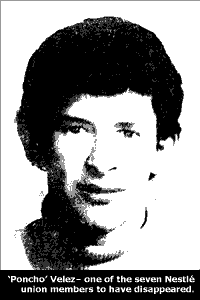
union in 1982. According to SINALTRAINAL seven of its members working
at Nestlé have been assassinated since then.
The principal perpetrators of such disappearances are the paramilitary
death squads. Although there is a certain separation between the agents
of repression and official entities, the links are an open secret. Human
Rights Watch reports that it was officers in the Colombian army who
set up the AUC’s Calima Bloc, a new paramilitary front established
to attack the social movement in towns in the Valle de Cauca in 1999.
 |
Although there is
no evidence connecting Nestlé with these murders, the logic of
the human rights violations, to remove trade unions and other social
movements, corresponds with the company’s own aggressive stance.
There are at least three cases that indicate a policy drive direct from
Nestlé itself to liquidate the union’s presence from its
Colombia operation.
For example, in the final weeks of 2001, management at Nestlé
subsidiary ‘Comestibles La Rosa’ threatened workers that they
must either renounce union membership or lose their jobs. Nestlé
subsidiary Cicolac also tried to break a collective agreement covering
400 workers, sack 96 workers and break the contracts of another 58 workers
so that their jobs could be contracted out through labour agencies.
Another example of Nestlé’s union busting activities is
the case of Agribrands Purina Colombia S.A., a national producer of
animal feed. According to the company, Nestlé is in negotiations
to purchase five processing plants, on the condition that the union
is terminated and all of the workers resign from their jobs. This will
enable Nestlé to lower production costs by hiring new workers
with temporary contracts, without a union organization, and without
a collective agreement. The 400 workers whose jobs are threatened have
worked for the company for an average of 18 years.
SINALTRAINAL claims
that Nestlé has also recently switched from domestic supplies
of fresh milk to imported milk products which ‘has generated misery
for small and medium dairy farmers and for peasants’. Nestlé
also benefits from the depressed market in coffee prices, which has
been wreaking havoc in the coffee growing areas.
SINALTRAINAL is a very good example of how workers in the developing
world have taken the initiative to internationalise resistance to the
multinationals. The Colombian union highlights the situation in the
Philippines, where the workers have been on strike against Nestlé’s
violation of pension rights. 13 strikers were beaten by the police,
and now the factory gates are guarded by a 200 strong private security
force.
In the words of
the union:
“Nestlé converts the factories into camps for the public
security forces in order to create terror in the community, destroy
the unity of the workers, and misinform the members of the union, with
the goal of putting them against the leaders and destroying the movement.
This is the policy of Nestlé all over the world. This reality
urgently demands the globalization of solidarity against the globalization
of misery, oppression, and death of the communities.”
For more information
on the Colombian Solidarity Campaign contact: colombia_sc@hotmail.com
Corporate Watch Nestlé profile: www.corporatewatch.org.uk/profiles/food_supermarkets/nestle/nestle1.html
|