 Some artificial intelligence (AI) researchers say that when an AI reaches a level of sophistication similar to that of a human being that humans will rapidly become obsolete. Once AI reaches a sufficiently advanced level, they argue, it will begin to design and redesign itself through ever more rapid advances in intelligence and power. We have to ask why the arbitrary level of human intelligence should be considered so significant.
After all a corporation is little more than an AI, a highly complex legally defined program with one over-riding purpose – the generation of profit. Other priorities are simulated only in crude terms. Some concerns such as health and safety, or the long term survival of the biosphere are hardly represented at all, except as text files under the heading ‘PR’.
The virtual environment in which corporate programs exist are known as the financial markets. This are a description of the world in which everything (or at least everything that can be bought, sold or speculated upon) is simulated in only one term – money.
The programs that we have created, and given more rights than we give to real humans, are responsible for appalling destruction. Increasingly, they are regarded as cruel and soulless beasts, often as evil. Alternatively they might be described as just plain stupid, or infantile. They appear to be about as socialised as a year-old infant. And like infants they are concerned only with the immediate gratification of their own desires, leaving a trail of mess and destruction for someone else to clear up. Unlike infants however they possess far more power than their creators, and no one seems able to control them.
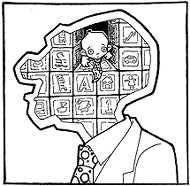
Rather than on microchips, corporate programs run as software on human brains. The majority of the processing power required to translate such highly abstracted, if not entirely imaginary concepts as ‘profit’ or ‘productivity’ must be performed by human consciousness. Indeed the human mind both shapes and is shaped by it.
But the human mind is capable of far greater intelligence than is required to run the corporate program and unwanted thoughts can intrude…
So how does corporate man deal with the problem? Living within the virtual world of the corporation he is not allowed to let certain issues affect his functioning. The conflict inevitably creates problems.
Luckily most corporate men are provided with sufficiently narrow tasks that they are never quite able to identify their own relevance to the destruction wreaked by the master program. Legal conventions, fictions even, insulate participants from responsibility for their own actions within the corporation. Furthermore the corporation tends to select only very particular kinds of individuals for the highest positions within the hierarchy. Only those who think most clearly in terms of the financial environment, to the effective exclusion of other information, are placed in controlling positions. And as Jim Hilton’s study of the social backgrounds of directors (pp.9-10) demonstrates those at the top are well insulated from unpalatable and disturbing information.
In a sense we are up against a program that exists within the psychology of human communities and human brains. We have the unique opportunity now to introduce disturbing thoughts, viruses, into the machine. We might aim thus to cause the destruction or the utter transformation of the corporate program itself.
The legal code upon which the corporation is based is hard to alter though, running as it does on similarly arranged and largely subsidiary communities of white middle class males. But the humans themselves on which these multiple layers of programming operate, and the communities within which they must exist (unlike their masters) are susceptible to new programming - new ideas. The awareness of ecological issues and the appalling inequalities in our world is spreading fast, and the desire to remedy this situation is also growing – even in the mind of corporate man.
So how are we to design the mental viruses (as is our right within a democracy) that will prosper in the mind of corporate man and short-circuit the master program? Surely the better we understand the complexities of the corporate world, the better we can aim our efforts to change it.
Nick Mayhew’s analysis, in our lead article (pp.4-7), makes clear what an extremely fragile beast corporate man has become. The inherent conflicts for humans working within a such an inhuman machine have forced him into an ever more untenable position, and increasingly he knows it. His inflexible Victorian masculinity is exposed by Katrina Fox (pp. 11-12), and the ever more anxious experience of ordinary workers is explored by Don O’Neal (pp. 13-14). May the astute reader of the articles that follow find useful insights into how the corporate world works.
Corporate Watch has long reported the harshest realities of the corporate world, aiming to inspire resistance and radical transformation. For this issue however we have chosen a very different approach. Our major theme is the psychology of corporate man himself. It is an attempt to understand both the people who perpetuate the corporate model, to go beyond the old ‘fat cat’ stereotype to a deeper, and (hopefully) more useful, understanding. And to dissect the machine itself, to understand how it continues to operate, apparently unaware of how it is making more and more of life obsolete.
As I hope will become clear, corporate man himself is an important key to unlocking the secrets of the machine…
An experimental comment by Chris Grimshaw