|
|
Magazine Issue 5&6 - Winter 1997
|
||
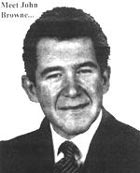 BP- Top Dogs and Fat Cats BP- Top Dogs and Fat CatsBP, like all transnationals, is an economic structure, a machine, an inhuman entity. Yet the cogs in this machine are people, from the forecourt attendant, to the geologist, to the refinery manager, to the top executives. Here Phil Watts introduces us to some of the people at the top. BP is run much like a country, like the UK. Its figurehead, the Chairman Peter Sutherland, is like the Queen in that he is less powerful than the man below him, Chief Executive John Browne. The Chief Executive acts in conjunction with five Managing Directors (see right), his ministers. Each of the Managing Directors has a particular area of business - a ministry - and is responsible and for part of BP’s foreign policy (dealing with a particular region of the world). Every company has its own particular culture, its history, its personalities. Although BP is an integrated petroleum company, it is exploration and production of which it is most proud. BP’s ancestor company Anglo-Persian made the first commercial oil discovery in the Middle East in 1908; BP was the first to find gas in the UK sector of the North Sea in 1965, and the first to bring oil ashore a few years later. Like Rockefeller’s Standard Oil, the company began by finding and extracting oil, and later vertical integration brought in downstream operations (refining and marketing). In contrast, the other UK oil major, Shell, began from distribution and marketing, and later looked for oilfields it could use to supply its markets. Indeed Shell bought much of its early supplies from Anglo-Persian. After the UK government sold its last major block of shares (31.5%) in 1987, BP was a cumbersome, inefficient, sprawling company, with a crisis of debt and a share price of only 185p (it is now over 900p). As Chief Executive from 1992-1995, it was Sir David Simon, perhaps the most respected figure in BP’s recent history, who turned the company around. The global work force was cut from 117,000 to 56,000, the process of selling of non-core operations (such as feedstuffs, minerals and mining) was continued, and the company was focused on its three core businesses: BP Ex (exploration & production), BP Oil (refining & marketing) and BP Chemicals. Of these, BP Ex drives the company and makes it stand out amongst its competitors. The value of the company is linked to the value of BP Ex, which depends not so much on how much oil BP is producing now, as on what it will be able to produce in the future. BP is led by its drillers. John Browne earned his stripes as an engineer in Aberdeen; Rodney Chase (head of BP Ex) is effectively second-in-command, with another BP Ex man, Richard Olver, due to join the Managing Directors in January 1998. BP Solar, on the other hand, is seen as something of a joke within the company. To those who’ve spent their lives drilling for billions of barrels of crude in the harshest conditions, a photovoltaic cell producing just 75 watts on the brightest summer’s day seems like a toy. BP Solar has no real representation at Board level. These seven men in their fifties rule BP, with the assistance of the Board of Directors and the Global Business Centre. The Board of Directors consists of these seven, plus nine non-executive directors, who come from the British Establishment and other major companies. They represent those organisations to BP and vice versa. They are like diplomats or ambassadors - except that they have real power. They can sack the Chairman or Chief Executive if they feel that person is not acting in the interests of the shareholders, and indeed did so with Robert Horton in June 1992, who had been Chairman and Chief Exec for just two years. The non-executives are: Sir James Glover (Royal Armouries Intl; Merlin Communications; Commander in Chief of UK Land Forces until 1987). Lord Wright of Richmond (Unilever; BAA; Chair of Royal Institute of International Affairs; Former Permanant Under-Secretary and Head of the Diplomatic Service). Sir Robin Nicholson (Pilkington Optronics; Rolls Royce; Council for Science and Technology). Charles Knight (IBM; Emerson Electric; Anheuser-Busch; SBC Communications). Dr Karen Horn (Bank One, USA; Eli Lilly; Rubbermaid; TRW). HMP Miles (John Swire & Son; BICC; ING Baring Holdings; Johnson Matthey). Sir Patrick Sheehey (Marlborough Underwriting Agency; Alda Properties; Celtic; Sherritt Intl.) Sir Ian Prosser (Bass; Lloyds TSB). Situated in Britannic House, Finsbury Circus, the Global Business Centre runs the day-to-day operations of BP. It has 14 members: the five Managing Directors; the Chief Executive; the Chairman and seven others - such as the group treasurer. They are assisted by approximately 1,000 administrative staff. Rodney Chase - Chief Executive of BP Exploration and Production. Responsible for the Americas. Colombia falls doubly under his authority. Rodney is a keen golfer, reportedly a tough character and possibly the man who made the decision to sue Greenpeace over the Stena Dee in August 1997. Bryan Sanderson - Chief Executive of BP Chemicals. Responsible for Asia Pacific + Indian subcontinent. The rapid expansion of BP Chemicals works in China, Korea and Malaysia has been guided by his hand. Bryan was one of Tony Blair’s “Three Wise Men” who advised on new competition policy in January 1997. He paved the way for his former boss, Lord Simon, to be appointed as minister on European trade and competition in May 1997. Dr Rolf Stomberg - Chief Executive of BP Oil. Responsible for Europe + former Soviet Union. Rolf’s remit gives him an overview of the rapid expansion of oil retail (petrol stations etc.) in Eastern Europe, Russia and the Ukraine as well as the highly profitable downstream merger between BP and Mobil in Western Europe. Rolf is set to retire in January 1998. Russell Seal - responsible for human resources, research, engineering, health and safety and environment. Responsible for Africa + Middle East. Russell is technically the overseer of BP’s moves to reduce gas flaring in the North Sea as well as BP’s huge oil finds in Angola and the maintainence of a low-profile for BP’s huge gas projects in the slaughter-house that is Algeria. Russell is set to retire in January 1998 John Buchanan - Chief Financial Officer, and responsible for the BP Global Business Centre. John is the newest managing director, only appointed in August 1996 and the first New Zealander to get to this level in the company. John Browne is widely reported to be a whiz-kid, referred to as “brilliant” within the company and described in The Financial Times Survey of European Most Respected Companies (September 1997) as a visionary manager. At 49 he is possibly the youngest chief executive of any major TNC. He is dedicated to his work; described as an “18-hours-a-day-man”, taking at most a one week holiday four times a year. His father, Edmund, worked for BP but died long ago and John lives alone with his Romanian-born mother, Paula, in Belgravia, London. He enjoys the ballet and opera and frequently attends Covent Garden Opera House with friends. But mostly it’s the company that fills his life as he travels the globe, on call 24 hours a day, seven days a week. For his labours he is well rewarded. In 1996, he earned £2.4m (including £1.7m from share incentives) plus he has the benefits of his office and staff, the doctor, dentist and catering services at the Global Business Centre, his company car and driver. All these bring his annual salary up to about £2.7m per year. By comparison, the manager at a BP petrol station in London, works similar hours (12 hours a day, 6 days a week, and permanently on call) and receives £14,000. He often faces the threat of robbery and violence on the night shift and is definitely not the lowest paid of BP’s staff. Yet he earns 193 times less than John Browne. John Browne, unlike some of the non-executives directors of BP, is no aristocrat; indeed he’s a model example of the relatively meritocratic culture within BP. “Relatively” because it is unlikely that anyone who is not male, white, Northern European or Anglo-Saxon will become a managing director of BP for sometime yet. Like all the other managing directors, John Browne went to university; like ex-chairman David Simon, he went to Cambridge University and studied engineering. Like Russell Seal, he undertook postgraduate studies at Stanford Graduate School of Business in California and it was at Stanford that he chose to make a key speech about climate change on 17th May 1997. This speech not only sets BP on an “apparently” new course but also demonstrates the tone of John Browne’s rule. Appointed chief executive in June 1995, Browne spent much of the first 18 months of his new job being over-shadowed by the chairman, David Simon. Following the disaster of Robert Horton (1990-1992) the non-executive directors in charge of BP were wary of control slipping to unsure hands. David Simon was credited with having turned BP around between 1992 and 1995 and so he held a firm grip on the company despite being “pushed upstairs” to the role of chairman in 1995. It is perhaps significant then that Browne should have announced a new departure for BP so soon after David Simon gave up the chairmanship in May 1997 and passed it to the relatively inactive interim-chairman, Peter Sutherland. Power in BP has once again gravitated back to one key player - John Browne. Throughout the summer Browne has expended much time promoting himself as the daring chief executive who’s prepared to break from the pack and make BP stand alone as the only oil major to address climate change seriously. The question that remains open is how significant are these statements? Do they show a change of course? Or that the profitability of BP over the last three years is allowing it to splash out on some extravagant PR? Or are they merely the actions of a childless, lonely, obsessive millionaire who wants to make a mark in his brief reign as a ruler of BP? Addresses: British Petroleum, Britannic House, 1 Finsbury Circus, London EC2M 7BA. tel. 0171 496 4000. John Browne, 21 South Eaton Place, London SW1W 9ER. Peter Sutherland, 68 Eglington Road, Donnybrook, Dublin. Rodney Chase, 4 Eaton Terrace, London SW1W 8EZ. Bryan Sanderson, 40 Netherhall Gardens, Hampstead, London NW3 5TP. Rolf Stomberg, 4 Templeheath Lodge, Templewood Ave, Hampstead, London NW3 7UY. Russell Seal, Gorse Bank, Enton Green, Godlaming, Surrey GU8 5AN. John Buchanan, Fernshaw, Rockfield Rd, Oxted, Surrey RH8 0HA. |