Gordon Brown's last budget included proposals to close a loophole which has allowed multinationals to avoid millions a year each of corporation tax by shifting profits abroad. Vodafone claim that paying as much tax as they ought would be too much of a hardship and is threatening to relocate its headquarters to Dublin, where they've heard there's some nice green fields to concrete over. The Confederation of British Industry is trying to go over Brown's head by threatening Blair with bad press in the run-up to the next general election. The only explanation is that the multi-nationals have been pulling this dodgy loophole so wide they would be hit quite hard if it were closed.
'Let them eat Coke.'
Last June, presumably in an attempt to relieve the years-long famine afflicting the people of North Korea, Coca-Cola became the first US company to sell its products in North Korea just days after the US lifted sanctions. Never mind if the harvest's failed, you can't feed your children, the water's polluted and the government doesn't give a shit - now you can buy Coke - if you've got any money, that is...
UN calls WTO 'nightmare'
A UN study team reporting to the Human Rights Commission has recognised what most of us knew already: if you live in a poor country, the WTO sucks. According to the report, the rules of the WTO are based 'on grossly unfair and even prejudiced' assumptions and 'reflect an agenda that serves only to promote dominant corporatist interests that already monopolise the area of international trade.'
Safety drive
The US tyre manufacturer Firestone, a subsidiary of Japanes-based Bridgestone, has finally admitted partial responsibility for the deaths of at least 88 people killed in accidents caused by Firestone tyres. The US press calls it a scandal - company neglects safety to make a quick buck, then tries to cover up to avoid lawsuits. We'd call it capitalism.
Japanese Jekyll and Hyde
When is a Japanese corporation not a Japanese corporation? When it's being accused of using forced labour. The US incarnations of conglomerates Mitsubishi and Mitsui both denied their own identities last month in the face of a lawsuit by nine Chinese nationals claiming to have been enslaved by Japanese companies under horrific conditions during WWII. But according to the companies concerned, the Mitsui of today is totally separate from the Mitsui of the 1940s and merely happens to share the same name, while Mitsubishi similarly claim there are several Mitsubishis (good Mitsubishis and evil Mitsubishis, presumably, it's a bit like Pokemon) and the US one has no connection to the bad ones.
E-Paranoid
If you thought corporations didn't give a damn what activists say about them, think again. The website www. ewatch.com, which names major US PR firms such as Burson-Marsteller as 'authorised re-sellers', offers companies not only a clipping service monitoring web references to their company or products, but also the 'cybersleuth' system which claims to identify 'entities whose motives are fraudulent, deceptive or criminal' behind web 'attacks'. Activists are high up their list of undesirables. Advice is also given on stamping out these cockroaches - up to and including arranging arrest of the 'perpetrators'. Worried? For your peace of mind, one concrete example of 'counteraction' listed on the site relates to Northwest Airlines debunking a story about one of their pilots posted on alt.urban.legends - serious stuff, eh?
Meanwhile, a Novartis press release plugging their new 'Positech' marker gene is less than upbeat, '[Positech] involves known and unknown risk, uncertainties and other factors that may cause the actual results to be materially different from any future results, performance or achievements expressed or implied by such statements...' Or in other words, 'if it doesn't work, don't blame us'.
Strike where it hurts
Telephone workers at Verizon phone company in the US have scored the first victory in the fight for union recognition in the so-called 'new economy'. After a two-week strike by 87,000 workers in August, unions led by the Communications Workers of America secured the right to union recognition for workers in the Verizon wireless (i.e. mobile) division, if a majority of workers sign a union card. Rumour has it the CWA is next considering organising at Microsoft.
...while greenwashing big business
Meanwhile, a different bit of the UN has laid itself open to accusations of selling-out and window dressing by co-ordinating a 'voluntary' regulation exercise by 50 'dominant corporatist interests' including Nike, Shell and Rio Tinto. The 'Global Compact' will see corporations posting information about their human rights, social and environmental performance on a website for UN officials and others. Maria Livanos Cattaui, secretary-general of the International Chamber of Commerce, said, 'business would look askance at any suggestion involving external assessment of corporate performance.' Or in other words, 'you'll have to trust us'.
Dole-ing out gongs
Anyone who watches the international awards scene closely probably had a good laugh a couple of years ago when Fidel Castro walked off with the Muammar Gaddafi Human Rights Prize (no, we didn't make that up). Similar things are going on in the corporate sphere. Back in July, at an event known as the Corporate Conscience Awards (pass the sick bucket) Dole Food Company, best known as the world's largest banana producer, received the Social Accountability International (SAI) Ethical Workplace Award. This was largely based on the behaviour of a subsidiary in Spain, but the company as a whole was praised on a variety of fronts including being the world's top food company for environmental management and its laudable efforts to help Honduran victims of Hurricane Mitch. It's worth noting that this is the exact same company which is currently trying to wreck Caribbean economies by its role in the 'banana wars', and has been accused of spraying its banana plantations with pesticides while unprotected workers are in the fields. In relation to Hurricane Mitch, try this extract from an article by David Ransom (New Internationalist October 1999). After describing how the banana giants (including Dole) used damage by Hurricane Mitch as an excuse to sack workers in Guatemala, Ransom goes on:
'At COBSA (a front company for Dole) they went one stage further. Members of the 'yellow' company union were induced to make legal compaints against the independent trade union, claiming its members were responsible for 'damages and prejudice' valued at $75m in the wake of Mitch. Armed guards with dogs stripped the roofs off their houses to force them to leave the plantation...' Ethical Workplace Award? Perhaps not.
Ibiza club enslaved to corporate spin
A new partnership opened up on the party island of Ibiza this summer when the Manumission club announced a sponsorship deal with mobile phone company Orange. Asked whether he believed in the Manumission company motto 'freedom from slavery', the man from Orange spun this for the punters: "I wouldn't go so far as to say we believe in freedom from slavery. We certainly believe in freedom - that's what the wire-free future is all about."
Oil & Gas industry contributions to the US Presidential Race 2000
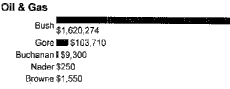 From the Gulf War to prices at the gas pump, American dependence on oil has been a longstanding issue of huge financial interest to the oil & gas industry. Oil companies consistently give the bulk of their political dollars to Republicans, whose support for opening wilderness lands to oil exploration and opposition to increases in fuel efficiency standards bode well for the industry's bottom line.
Most industries and interest groups have given record amounts in this year's US election cycle. This includes the oil & gas industry which has eclipsed its previous figures. (Contributions to particular candidates broken down in graph opposite).
Figures based on Federal Election Commission data, 3/7/00. Source: Center for Responsive Politics (US), www.opensecrets.org
Goodbye to brown envelopes
The government is planning a crackdown on the mainstay of British business success abroad since colonial days - bribing the locals. In June, a Home Office white paper suggested making it illegal for companies to offer bribes to officials, even when working outside the UK. Reaction from the business community was predictably muted; Ruth Lea, head of policy at the Institute of Directors, said: 'British business has a very good reputation for honesty and integrity.'
"You might not see things yet on the surface, but underground, it's already on fire" Indonesian writer Y.B. Mangunwijaya
