 |
|
Click to enlarge.
|
A powerful set of economic and political interests lie behind the military repression of Zapatista communities in Chiapas. It is much more than a conflict over new political relationships between the indigenous population and local landowners. Given that this southernmost state of Mexico is rich in natural resources – in particular oil and biodiversity – what is at stake is the voracious expansion of global capitalism itself. Chiapaslink investigates.
The six-year conflict in Chiapas crystallises the contradictions between two radically different models of development. On the one hand, the Zapatista Army of National Liberation (EZLN) emerged in January 1994 declaring NAFTA (the North American Free Trade Agreement) a "death sentence" for the indigenous population. Their Agrarian Law demands that fertile lands be returned to the indigenous and poor campesinos as the material basis for organising their lives and culture. It also orders forest, rivers, lakes, oceans and sub-soil minerals to be liberated from capitalist corporations and government monopolies and restored to the keeping of local populations - partly for use, partly for ecological preservation.1
 |
| Click for picture enlargement |
On the other hand, Mexico’s ruling party the P.R.I. (Institutional Revolutionary Party) has embarked on a process of privatising just about everything. Ports, airports, railroads, urban public transport, satellites and telecommunications are being sold off to powerful transnational firms in order to ‘grow’ the country out of the massive debts it accumulated up to 1982. Its US-educated leaders have eagerly swallowed the free-trade pill and celebrated the country’s accession to First World status on the day NAFTA came into force. Chiapas is equally the focus of numerous private investment projects, with developments such as the US$5 million agreement between the International Finance Corporation3 (a member of the World Bank Group) and the Fondo Chiapas in February 1998. The director of the Latin American and Caribbean division reminds potential investors that, "despite its less-developed status, Chiapas is rich in natural resources, labour, climatic conditions and tourist attractions".4
Chiapas has always been of strategic importance to economic development in Mexico and to world capital, just as the indigenous communities have gradually, and almost always violently, been expelled from the most fertile regions to the most inhospitable and poor quality lands. From the time of the Conquest, a wide variety of tropical products from Chiapas made their way into the world market, including cocoa, wood, rubber and more recently, coffee, oil and cattle. However, as Andres Barreda and Ana Esther Cecena point out,5 the economic profile of the state has changed over the last two decades. New national and international interests are seeking to take advantage of some of the other enormously rich natural resources.
According to the National Commission for Democracy in Mexico, Chiapan oil from the north-west of the region accounts for 81.2% of Mexico’s crude exports, 68.6% of its petroleum derivatives and 90.6% of its petrochemicals.6 However, numerous sources point to the existence of gigantic oil deposits in the north-eastern region of Chiapas. As Andres Barreda underlines, "clarifying this point is essential because of the way in which the much desired privatisation of Mexican oil fields implies the violent expulsion of tens of thousands of indigenous campesinos from their land."7
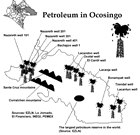
Evidence of oil deposits comes from a combination of reports from the US General Accounting Service,8 the Oil & Gas Journal,9 from parts of a confidential map obtained by La Jornada,10 along with confirmation of oil drilling by two Canadian companies (Seine River Resources and Alpine Oil Services Corporation 11) and testimonies of campesinos who have worked directly with foreign exploration companies. Zapatistas claim that the Mexican government intends to sell the rights to the oil-rich pockets of land to foreign companies. They calculate the values of these rights at some US$80 billion for state-owned oil company Pemex and untold billions more for the companies who would buy or lease the land. Shell and Exxon are already providing technical assistance within Pemex exploratory work.
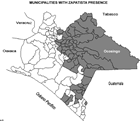
The maps of these petroleum areas show numerous Zapatista autonomous municipalities located on top of, or very close to, these oil deposits or new wells.
Zapatistas also allege that oil has been the motivating factor in the positioning of Mexican army troops throughout the Lacandon rainforest, and in particular the occupation by soldiers of the village of Amador Hernandez and the construction of a new road by the army. The Amador Valley, on the edge of the Montes Azules Biosphere, stands out not only because of its oil, but also as one of the 74 places in the state of Chiapas in which new privatisable hydroelectric dams could be built. Chiapas already provides 55% of Mexico’s hydroelectricity. The Chiapan jungle is considered to be one of the few regions in the world where multiple dams of significant size can be constructed.12
Patrich Fabriaz, adviser to the Greens in the French Parliament, suggests that French and US oil companies could be involved: "The issue of Chiapas is not just a question of Mexico. It is international… the military is certainly intervening in order to have a stable climate during the elections, but, more than anything, in order to safeguard the oil that’s been detected there... They’re looking for oil and it’s obvious that it’s important for the oil companies that the Zapatistas get out of Chiapas... Oil makes war. The oil companies are always behind it."13
Biodiversity represents the future of world capital. Regions of the world with the greatest biodiversity - such as Mexico, which is reported to be the third most biodiverse country - are gaining strategic importance. In Chiapas, the Lacandon rainforest has a varied geography, which contains 34 eco-climates (compared to only 4 in the US), and with only 1.3% of land worldwide, it contains 14.4% of species in the world.14 This makes it fertile ground for bio-prospectors and would-be genetic pirates. Xenova, for example, a UK biotechnology company that specialises in the development of novel drugs to improve the treatment of cancer, is negotiating terms with the Mexican government to gain access to the Chiapas region.15
Already underway is a project led by the University of Georgia in co-operation with the Mexican university research centre Ecosur and the UK biotech company Molecular Nature Ltd.16 This project aims to collect and evaluate thousands of plant species and micro-organisms used in traditional medicine by Maya communities. The project estimates that it will ultimately identify approximately 2000 unique compounds that will be chemically profiled by Molecular Nature.
Indigenous peoples’ organisations in the state, eleven of whom have formed the Council of Indigenous Traditional Midwives and Healers of Chiapas (OMIECH), are outraged by the scheme. They are demanding that the program suspend its activities, and have appealed to all indigenous people in the region to refuse to co-operate with Ecosur researchers. According to Sebastian Luna, an indigenous Tzeltal spokesperson from the Council:
"The project is a robbery of traditional indigenous knowledge and resources, with the sole purpose of producing pharmaceuticals that will not benefit the communities that have managed and nurtured these resources for thousands of years. The project explicitly proposes to patent and privatise resources that have always been collectively owned."17
Equally objectionable are the activities of the so-called ‘environmental’ NGO Conservation International (CI). Whilst stating that their mission is to conserve the Earth's living natural heritage and global biodiversity, and to demonstrate that human societies are able to live harmoniously with nature,18 the group is funded by the likes of Exxon, Ford Motor Co, United Airlines, Intel, Walt Disney, Pulsar and McDonalds.19 It has an office in Tuxtla Gutierrez, capital of the state of Chiapas, and is working actively in the Selva Lacandona, where it promotes four projects: eco-tourism, artisanry with Tzeltal women, environmental protection and ‘sustainable’ development of natural resources in the Montes Azules Biosphere Reserve.
Rural Advancement Foundation International (RAFI) includes Conservation International in its global list of companies who are carrying out bio-prospecting and bio-piracy. CI is already collecting plants and micro-organisms in the countries where it works and is ‘strategically allied’ with multinational pharmaceuticals. The positioning of the Zapatista autonomous municipalities, many of whom live in the Lacandon rainforest, undoubtedly presents an unwelcome obstacle for the biotechnology industry.
The state of Chiapas is now seething with tanks, helicopters, military barracks and paramilitary groups. Over 70,000 troops have been positioned next to Zapatista villages, in a show of strength which is totally disproportionate to the number of EZLN guerillas. The Mexican government buys most of its arms and equipment from the US and sends the greatest number of forces to US military schools such as the School of the Americas, well-known for its counter-insurgency training to Latin America’s armies. A number of UK arms companies have also sold to Mexico since 1994: Pilatus Britten Norman (a Swiss/UK company), Heckler & Koch (owned by British Aerospace), SDMS and Smith & Wesson.
The primary goal of the Mexican government is to demonstrate to foreign investors that they will find a favourable climate for their business. This ‘favourable climate’ has to do with the removal of those people who do not serve the interests of transnational capital and who therefore represent an obstacle to economic growth and the extraction of resources. This includes most of the indigenous population of Chiapas. In January 1995, a month before the Mexican government unilaterally broke the cease-fire and launched its military offensive against Zapatista strongholds, the Chase Manhatten Emerging Markets Group spelt out exactly how unwelcome an obstacle these indigenous communities are:
"While Chiapas, in our opinion, does not pose a fundamental threat to Mexican political stability, it is perceived to be so by many in the investment community. The government will need to eliminate the Zapatistas to demonstrate effective control of the national territory and of security policy." This vital aspect of the military repression in south-east Mexico has often been overlooked. What is at stake is the battle between big business in the search for huge profits, and local populations and the ecosystems they have inhabited for centuries.
Or Chiapaslink, Box 79, 82 Colston Street, Bristol BS1 5BB
Also available: ‘The Zapatistas: A Rough Guide’ (see review section)
Footnotes
[1] Cleaver H, Introduction, Zapatistas! Documents of the New Mexican Revolution, 1994, Autonomdeia, New York
[2] Winden, "The Dialogue in Chiapas: Time is not the Essence", in The Other Side of Mexico, May-June 1995, No 4
[3] see http://www.ifc.org
[4] Karl Voltaire, http://www.ifc.org/pressroom/Archive/1998/fondo.htm
[5] Cecena A & Barreda A, in Holloway J (ed), Zapatista! Reinventing Revolution in Mexico, 1998, Pluto Press
[6] NCDLJ Research on US Financial Interests in Mexico, Feb 1998
[7] Barreda A, "Militarisation and Oil in Chiapas", La Jornada Aug 17 1999
[8] In 1992, the GAO prepared a document on Mexican oil for the U.S. Congress, which discussed explicitly the significant deposits in the Ocosingo area. "PEMEX officials informed us that they have recently discovered a large field in the state of Chiapas, close to Ocosingo."
[9] Helu P & Meneses Rocha wrote in June 1998, "after ten years of exploration and development, the focus of attention has moved towards the coast and the mountains of Chiapas, resulting in significant discoveries of light and condensed oil and gas."
[10] La Jornada has obtained segments of one of the maps produced by a private Swiss consultation group called Petroconsultants identifying a deposit named the Sierra de Chiapas region which reaches from Tuxtla Gutierrez through Ocosingo and south. Petroconsultants sell maps to the worlds big oil companies for thousands of dollars and has an exclusive aggreement with PEMEX
[11] Tenuto M, "Oil and Military Occupation in Chiapas", Chiapas Support Committee, Oakland
[12] NCDLJ Research on US Financial Interests in Mexico, Feb 1998
[13] Guillen G, "US and French Oil Companies Could Exert Pressure for a Solution", in El Universal Aug 24, 1999
[14] Chiapas Al Dia 175, http://www.ciepac.org
[15] Pilling D & Bardacke T, "Genetic Pirates Walk the Plank", Financial Times, 09/01/99
[16] for additional information on this agreement, see http://www.nih.gov/fic/opportunities/icbg.html, and http://www.ciepac.org/bulletins/Ing175.html
[17] quoted in "Biopiracy Project in Chiapas, Mexico Denounced by Indigenous Groups" News Release 1 December 1999, http://www.rafi.org/news
[18] http://www.conservation.org
[19] Gustavo Castro Soto, CIEPAC, ciepac@laneta.apc.org