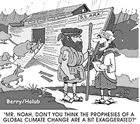
 Climate Change – no safe haven
Climate change is happening; it is affecting every part of our ecosystem; and the way globalisation currently works means it is inevitable, at least in the short term.
This is frightening and no-one is saying any different – whether ‘left’ or ‘right’, advocate of gradual change in due course or revolution now.
The climate change-themed articles of this magazine look at some of the political trends surrounding the issue. As corporations themselves start investing in solar energy, or use rhetoric of which any anarchist would be proud, decrying governments’ inability to act, the clear water around corporate behaviour becomes muddied. At this point it becomes more difficult to analyse whether the corporate grip on political power is being loosened and radical change is taking place – or whether corporations are merely shifting shape and ducking the systemic changes needed to halt climate change and reconsider humankind’s relationship with nature.
The next international institutional attempt to address climate change takes place at The Hague in the Netherlands this November with the next round of meetings (COP6) of the UN Framework Convention on Climate Change. This summit will take forward agreements made in Kyoto in 1997 and will try to figure out exactly what has to happen to stop our glorious Corporate Watch cover girl from taking to the stage.
The nuclear industry is getting excited: as part of negotiations leading up to COP6 the UK government is lobbying for nuclear power, which does not produce CO2, to be part of the Clean Development Mechanism. This scheme is an opportunity for ‘developed’ countries to claim carbon credits if they help ‘developing’ countries to install clean technologies. BNFL is already competing to sell nuclear power stations to China, using carbon credits as a selling point.
Plans for COP6 are largely based on extension of emissions trading, a mechanism examined by Larry Lohmann on page 4. Corporations, which favour this scheme, are grasping at straws. It is an instinctive response for them to act in this manner – to look to an extension of capitalism as a solution. This of course will not address our CO2 output. For the past four decades, the output of CO2 and Gross Domestic Product (GDP) from globalised industry have increased almost exactly in proportion to each other. Breaking this ‘lockstep’ means a dramatic cut in emissions - implying a major change from current ‘business as usual’.
A basic question still remains: is it possible to ensure the survival of a planet through social structures which are inherently inequitable and oppressive? The answer quite simply is no, it is not. Not just because life has to be recognised as more than a commodity, but also because neither civil society nor our complex ecosystem are passive entities which will obligingly accept their own demise.
One framework attempting to create political space to tackle climate change is ‘Contraction and Convergence’, outlined by Aubrey Meyer on page 8. This framework uses a solid scientific grounding to look at more equitable distribution and to allow for the atmosphere to be viewed as a common resource for all life on the planet. Contraction and convergence avoids ideology yet keeps at its heart the alleviation of oppression.
Contraction and convergence takes a pragmatic stance of starting from the world as it currently operates, yet refers to the overall framework of equity. It gives rise to a number of questions:
• If contraction and convergence were to be seriously considered by the powers that be, would this mean being watered down to become meaningless?
• How radical a context does this framework present for emissions trading and the complexities which this throws up?
• What conclusions do we draw from the recognition, forced upon us by climate change, that we are part of an ecosystem?
Considering a strategic response to climate change will throw up difficult questions – that is inevitable when you begin to engage with the issue. However, burying your head in the sand has never been a safe haven and the scale of climate change is crying out for a response. It also calls for coalition-building and action at a range of levels – some ideas for this are thrown into the pot by S.L. Maybe on page 10.
Moving beyond despair or denial around climate change is essential. Aubrey Meyer presents this effort as one which: "seeks to recognise the political space between disinterest, doubt and despair about climate change, since without the effort to create such a space we all may go rapidly from confusion to conflict with nothing in between".