S. L. Maybe considers… Climate change scientists have spent the last few years testing alternatives to the idea that people are affecting global climate. None of the factors such as the climate’s natural variability, or changes in solar radiation, fit the past century’s observed warming as well as increases in greenhouse gases generated by human activity. This year they concluded that "there has been a discernible human influence on global climate" 1.
Wake up and smell the coffee
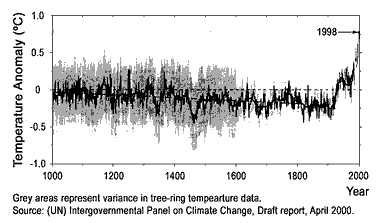
Here’s what Shell, Toyota, Boeing and eighteen other transnational corporations stated in an international advertisement: "The earth is warming. The 1990s were the hottest decade of the entire millennium and 1997, 1998 and 1999 were three of the hottest years ever. The growing scientific consensus is that this warming is largely the result of emissions of carbon dioxide and other greenhouse gases from human activities including industrial processes, fossil fuel combustion, and changes in land use, such as deforestation... Unaddressed, climate change will have significant impacts... around the world... The possibility of catastrophic events also cannot be ruled out."2
What’s the cost of climate change? Eight of the last 11 ‘disasters’ for which the global relief aid agencies have mobilised were due to climatic extremes. Late last year mudslides in Venezuela left 20,000 dead, while 10,000 were dead or missing as a result of a cyclone in Orissa, India. These weather extremes are not confined to far-off places as the storms in northern France late last year attest.3 The numbers of these climate-related disasters are doubling every decade, from 16 disasters in the 1960s to 70 in the 1990s, according to the reinsurance giant Munich Reinsurance.4
It is clear that carbon dioxide emissions must be drastically reduced - 60%-90% say most scientists - in a short period of time. But where is the international outcry? Where are the groups, movements and their campaigns for halting carbon dioxide emissions? Why is climate change, and specifically demanding and taking action to work towards 60%-90% reductions in carbon dioxide emissions, not at the top of anyone’s political agenda?
The answer to this is that tackling climate change is not a relatively straightforward problem, with a single solution, like stopping GM crops, or protecting the ozone layer. These examples are theoretically easy to stop - just don’t plant GM crops, and the rest stops. Climate change is qualitatively different, as carbon emissions are linked to all aspects of our life: carbon is emitted in the manufacture of almost every manufactured product we buy, and every time we travel by motor vehicle carbon is emitted. Tackling climate change means accepting limits on our carbon output, which means tackling the issue of how to share out the carbon to be emitted between the world’s peoples. To retain a potentially livable planet - reducing carbon emissions by 90% - would require a revolutionary (meaning vast and rapid change) transformation (meaning no going back) of society. This is why climate change is not at the top of the agenda.
Minimising climate change requires us to, ‘be realistic, demand the impossible’, to return to an old phrase. The required action seems so far from the possible that reality must be ignored. Governments have traditionally been seen as the major agents of change, this is where we are supposed to channel our problems, and from where solutions will be implemented. Can governments deal with reality?
Most governments have to be re-elected, so governments have to be perceived as being less bad than their immediate opposition. Any government unilaterally deciding to massively reduce carbon dioxide emissions, by, say, large taxes on carbon emission stopping most imports and exports, would not get elected again because large job losses would follow as a result of companies relocating to somewhere with low carbon taxes. The Kyoto protocol, a set of negotiations to reduce carbon emisions, is designed to overcome this as all countries move together. However accords only go as far as domestic pressures allow the main players to go: this means the Kyoto protocol cannot deliver large enough carbon emissions reductions fast enough.
Perhaps big business can deal with reality better, as they face fewer constraints than government. If a large enough group of major transnational corporations collectively decided to radically reduce carbon emissions, they could do it, as long as they stayed profitable. If altering the climate is against the interests of future profits and profitable mechanisms can be put in place to minimise climate change then free market capitalism may be able to save our climate. This scenario is not beyond possiblity, as Rodney F. Chase, deputy CEO at oil giant BP Amoco, alludes: "If we accept the case for action on climate change, its clear we can’t wait for an international negotiation process to achieve consensus any more than we can wait for the scientists to reach complete and final agreement. Just as the corporate sector has been one of the driving forces behind the movement towards free trade over the last 50 years, so I now think the corporate sector can help develop the solutions to climate change... So overall we believe we can meet our greenhouse gases target in a cost-effective way. And we also believe that in taking actions to meet our target we will end up a stronger, fitter corporation."2
We should be clear that if corporations play a major role in tackling climate change they will perpetuate and increase current inequalities between people, both between and within countries. Different environmental problems will not be taken into account. The only criterion for ‘success’ is, as ever, being profitable, but sucess will require carbon limits. It will be an even harsher capitalism. The global elite, both business and their partners in government will further increase wealth and power, including new social controls based on carbon emissions: the planet is only ‘saved’, for example, if the masses are forbidden from traveling. Capitalism may save the climate, but at what price?
Perhaps what’s known as ‘civil society’, that is ‘the people’, may be able to deal with reality better than government and their capitalist friends. Civil society is made up of several components, of which I’d like to highlight two. Firstly, non-governmental organisations (NGOs), with an interest in climate change, such as Greenpeace, Friends of the Earth or Christian Aid. These groups have not suggested, and are not taking action to try new economic, political and social models that may allow 60-90% carbon emissions reductions. They cannot be agents of change themselves, as they merely lobby government, either directly through the media, or by encouraging public awareness/outrage. As I argue above that governments cannot successfully tackle climate change, and NGOs only lobby government, they can never ‘win’ a climate change ‘campaign’. However, they can provide the backdrop of public support that allows more radical action to go ahead, as happened with the anti-roads and GM crops issues.
The second component of civil society I’d like to consider are what are called ‘new social movements’, who take direct action around ecological and social justice issues. In the UK these fluid, often nameless, movements include the Earth First! network, Reclaim The Streets, the newer ‘anti-capitalism’ movement, or the ‘direct action’ movement. Globally they communicate through structures such as Peoples’ Global Action (see Corporate Watch issue 8 ‘Networks of Struggle’). In the UK the few thousand people involved in these networks have not engaged with the issue of climate change, but they do harbour a desire to radically transform society, dismantle capitalism and live within ecological limits.
However slim, it is in these movements that there is a possibility of minimising climate change, as these groups are explicit about a revolutionary (meaning vast and rapid change) transformation (meaning no going back) of society to one without oppressions and operating within ecological limits.
These movements might use climate change as practical yet illustrative politics. As society has to be fundamentally transformed to reduce carbon emissions by 60%-90%, the question is not whether a transformation of society is required but rather what sort (or sorts) of transformation this might be. The questions are no longer abstract about some future ending of capitalism, but practical and immediate, for example, what mechanisms would need to be developed to allow people to decide on the limits to carbons emissions, and how to enforce those limits in a truly free and fair manner? Taking action to reduce work and consumption would be seen as logical and necessary for anything but a very bleak future. Climate change could keep a revolutionary movement focused and practical, while not encountering all the problems and criticisms of ‘single-issue’ campaigning. Climate change is clearly not a single issue. Any serious attempt to tackle climate change will be rooted in our day-to-day lives, but will by necessity be mass-based, global and internationalist, thus strategic alliances can be made, and dialogue sought.
Here are a few action ideas that might help climate change take off, and continue to build a non-hierarchical movement for the social and ecological transformation of society. A simple ‘getting new people involved’ idea: stop internal flights in the UK altogether. This is direct action to stop the expansion of the fossil fuel economy.
It is easy as most people don’t use internal flights anyway, so few will be annoyed, those affected are mostly business people, and there is a clear alternative available (train). Actions could include shutting down internet sites of the plane companies, as most bookings are made on-line, occupying their call centres, occupying travel agents, and for the brave, airport actions.
There are proposals, some with planning permission, to build 15 gas-fired power stations in the UK. These sites could be occupied a la the anti-roads and anti-airports campaigns. Likewise camps could be used to undertake militant ecological restoration, where wildlife corridors could be created over a period on
squatted sites whilst links were developed with local groups who would continue to defend the site once the restorers had moved on. A bit like a road camp but in reverse!
 Finally, groups could declare a car-free day for their town/city, where people are asked not to drive into the city so as to save carbon. This is matched by large-scale training of people to blockade the roads in the morning of the said day, like in Seattle when the World Trade Organsation met. This could seriously disrupt major cities, while, if enough advance warning is given, and if done on a Monday to give workers a ‘long weekend’, and if clear reasons why the action is taking place are given, more people may be prepared to participate and support.
Given the seriousness of climate change, its impacts, and the changes required to ameliorate it, it cannot be ignored. We must embrace reality, and take concrete action to alter it to a new reality that reduces our oppressions and moves us towards living within ecological limits. Whatever sort of society you want to live in, you need a functioning planet to have a society on! So ignore climate change at yours, and everyone else’s, peril.
[1] Science Vol 288, page 590-591, 28 April 2000
[2] International Herald Tribune, pages 11-14, 27 April 2000
[3] The Guardian, page 7, 16 May 2000
[4] The Guardian, page 7, 15 May 2000