The Global Commons Institute is calling for equity to be at the core of the global movement to stop climate change. To entrench this it advocates a pattern of ‘Contraction and Convergence’. Aubrey Meyer explains.
Changes in global climate have never until now been caused by human beings. Now, human pollution to the atmosphere is accumulating so fast it is trapping increasingly more of the sun's heat than is released back to space. It is this rise in global surface temperature that is implicated in the more and more variable and violent weather events and damages around the world, in places like Honduras, Orissa and Mozambique.
These are as much social as environmental disasters, and the trend of their increase is well established and getting faster. Even within corporations’ own criteria for success - the financial bottom line - the situation is rapidly becoming untenable. Insurance industry figures for 'economic losses' from 'natural disasters', show damages growing globally at a staggering 8% a year since the 1960s. This is 5% faster than the rate at which we supposedly 'create wealth' measured as GDP (Gross Domestic Product). If this continues, the gross global destruction of wealth from climate change will actually exceed its alleged creation each year. A failure to act despite this glaringly obvious impending disaster demonstrates how fixed are the blinkers on the energy industry. The level of change needed is profound.
The scientific evidence linking these damage trends to human pollution is now accepted by most major scientific, political and commercial institutions. And yet they have failed to come forward with effective plans to slow the damages and to help the victims of those damages that aren't prevented. The dominant priority of business and governments remains the growth of financial profits in spite of this growing negative impact. A profit to whom, we might ask?
Contraction and Convergence means, in a nutshell, that all the countries that make up the United Nations Framework Convention on Climate Change (UNFCCC) would agree a revisable global greenhouse gas emissions 'contraction budget'. This would secure a precautionary and safe future stable value for the rising greenhouse gas concentrations - say 80% cuts globally by 2060. If we were lucky this level of cuts would return atmospheric concentrations to today's value within a hundred years and limit the worst of the damage.
The international shares in this budget would then be 'pre-agreed' on the basis of 'convergence' from now, where shares are proportional to income, to a target date in the budget time-line - say 2030 - after which they remain proportional to an agreed base year of global population. This means that 'over-consumers' like the US contract sharply, while 'under-consumers' like Bangladesh can continue to rise for a while. This is a politically feasible way of instituting a precautionary and equitable global framework, by applying the principle of 'equal rights'.
A rapid and orderly retreat from fossil fuel dependency in favour of clean and renewable forms of energy is obviously needed. And if there is any agreement to have international emissions trading, it must be structured to this end and secured on the basis of equity, as Contraction and Convergence, and even the UN’s own Climate Convention, require. As such, trade may play a vital part in preventing catastrophic changes in the climate by hastening the avoidance of emissions.
Contraction and Convergence is just a framework for the numerous and diverse practical actions and changes that are necessary to save the planet from climate change disaster. It is not a cure-all. But it may well be politically necessary if there is to be an effective, precautionary agreement at the global level.
Key to Contraction and Convergence is the need for it to also be empowering at a local level. With reference to the larger scheme, people can use the same argument to organise for equity within their societies and communities in their own countries. This is a radical approach – one which re-normalises equity at each level of political discourse.
Locally, nationally and globally, we all need an agreement to secure fragile and finite resources. Strengthening broad strategies to reach some agreement will not be easy. However, continuing our current behaviour is no more than an endgame for humanity with the rich finally committing suicide by continuing to rob the poor.
It is morally but also practically sensible to avoid this. Contraction and Convergence thus presents the simple idea of equity for survival. It puts the need to protect people and planet ahead of the need for profits. In practice we all do have equal responsibilities in this but it can only work as part of an overall agreement that is sustainable in total secured on the principle of equal rights.
The founding statement for this and the Global Commons Network is at http://www.gci.org.uk/indlet.html
Aubrey Meyer works with the Global Commons Institute - www.gci.org.uk
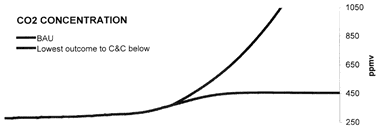
CO2 concentrations
Recorded rise in atmospheric CO2 concentration from 1860 until 2000 shows an increase of 34% over pre-industrial levels. This is a rise both higher and faster than anywhere in the ice-core sampling back 440,000 years before now. Concentrations are rising as the result of accumulating emissions. In future, the worst case is the upper line as Business-As-Usual (BAU). The best case sees this rise stabilised at twice today's level due to a 60% global contraction in the underlying emissions by 2100.
CO2 emissions
The upper line shows Business-As-Usual CO2 emissions. The solid segments show "Contraction, Convergence, Allocation and Trade" [C-CAT] to manage emissions down by at least 60% within a given time frame with an agreed 'contraction budget' (here 680 billion tonnes of carbon). The internationally tradable shares of this budget result from convergence to equal per capita by an agreed date and population base year (here 2020). The 'traded area' is the difference between that and convergence by 2100 (here, 100 billion tonnes). If this is invested in no-emissions technologies, risk and damages are lowered further as the budget is then net of these emissions as well.