|
|
Magazine Issue 10 - Spring 2000
|
||
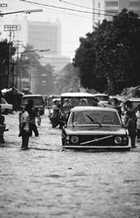 Requiem for a drowning planet Requiem for a drowning planet Families cling to tree-tops in Mozambique as the brown floodwaters rise beneath them. Fishermen hunt through the hurricane’s wreckage in Orissa for the bodies of loved ones. How long can people continue to deny a link between these increasingly common disasters and global climate change? Mark Lynas looks at the latest facts and figures, and finds that time seems to be running out for planet Earth. The climate change warnings are coming from strange places these days. At the recent World Economic Forum meeting in Davos, Switzerland, assembled business and government leaders were asked to vote on what issue they considered the biggest threat to business over the next century. The result – global climate change – so shocked the pollsters that they demanded a rerun. But climate change came top again, by an even bigger margin than the first time round. That said, big business isn’t about to change its ways anytime soon. A workshop at Davos on addressing climate change was only sparsely attended – the assembled CEOs were much more interested in discussing new routes to profit-making such as e-commerce and the ‘knowledge economy’. The truth is that when faced with an issue which clearly represents the biggest ever threat to human survival, the global elite is powerless to comprehend – let alone act – on the enormity of the changes it demands. Tackling climate change will require a root and branch restructuring of the entire economy, something the heads of corporations, governments and international institutions are incapable of facing. Their failure is our opportunity. Where the powerful have turned their backs, the world’s ordinary people must take up the challenge of saving the Earth’s climate and biosphere from disaster. And what a challenge it is. The scientific community’s current most likely scenario points to a sea level rise of up to 1.25 m over the next century. Yet the reality of climate change is unlikely to be a slow, gradual process. If you look at temperature change on a graph, the problem is not that the curve slopes upwards, but that it does so with runaway, exponential steepness (see graph, next page). What this means is that the systems which have made the Earth’s climate relatively stable since the end of the last ice age have already been knocked out of control. The biosphere’s self-regulatory mechanisms are locked in positive feedback, and the Earth is accelerating towards catastrophe. Runaway global warming For example, rising temperatures are melting permafrost in the tundra across Siberia, releasing vast quantities of new carbon dioxide and methane into the atmosphere, which in turn further worsen global warming. As tropical rainforest ecosystems collapse – as they are now doing under the combined assault of rising temperatures and human encroachment – the carbon they contain in their biomass is also entering the atmosphere. Half of the world’s tropical forests have already been lost in the last fifty years – and the rest could be gone in as little as thirty years more. While much of this tree loss is due to logging and the conversion of forest land to ranching or agricultural uses, the high temperatures and drying out of a normally water-soaked ecosystem means that man-made fires quickly burn out of control. In 1998 an area of forest the size of Costa Rica went up in flames – 40% of it in Brazil [1]. And since tropical forests contain most of the world’s biodiversity, this destruction is accompanied by species extinctions unparalleled in scale since the end of the dinosaurs. Rises in sea level, when they occur, could be as sudden as they are devastating. We already know that global warming is concentrated at the poles, and that giant cracks have begun to appear in some of Antarctica’s main ice sheets. In the mid-1990s the Larsen A ice shelf, measuring some 8000 square kilometres in surface area, broke away. The West Antarctic ice sheet is perched on submerged islands, with ocean water flowing underneath the ice. As sea temperatures rise, the entire ice sheet could be released into the ocean, where it would break up. The result would be three million cubic kilometres of melting ice – enough to raise sea levels worldwide by six metres. Even just a one-metre rise would begin to flood many of the world’s major cities – including London, New York and Bangkok, and would affect as much as 30 percent of the world’s total cropland [2]. The mechanisms which govern the climate and ocean currents are incredibly complex. However, it has long been predicted that global warming would lead to more intense and frequent severe weather events. Hurricanes, for example, occur only when sea temperatures rise above 27 degrees celsius – warm enough to drive a rising vortex of saturated air fast enough to kick-start a storm system. Between 1995 and 1998 there were 33 hurricanes in the West Atlantic – an all-time record [3]. Hurricane Mitch, which hit Central America in October 1998, was the most destructive storm in the Western hemisphere for 200 years – leaving 10,000 dead and 3 millon displaced. The damage was worsened by torrential rain running straight off hillsides left bare by deforestation – Nicaragua has lost nearly 60 percent of its forest cover in the last 50 years [4]. The cyclone which hit Orissa, India, almost exactly a year later, killed at least as many people as Mitch – and was the worst to hit the region for a century. While the South is suffering the worst from climate-related disasters already occurring, Europe could also find itself in for a shock. Recent scientific studies suggest that the Atlantic Gulf Stream, which is responsible for Western Europe’s temperate climate, could decline or shut down altogether as a result of disruption to the system from melting Arctic ice. That would plunge the UK and Ireland into a near ice-age, with a climate equivalent to that of Labrador in Canada or even Siberia. This has already happened once – about 8000 years ago – leaving Britain uninhabitable for early humans [5]. And today Arctic ice is already melting – between the 1960s and the 1990s, the average thickness of Arctic sea ice dropped from 3.1 metres to 1.8 metres. In the last 20 years alone, the area of sea covered by ice has shrunk by 6% - losing an average of 34,300 square kilometres - an area larger than the Netherlands - each year [6]. Kyoto’s deck chairs It’s clear that the price of not doing anything about fossil fuel emissions is already higher than the price of acting. Yet the response of national governments has been pitiful at best. The Kyoto Protocol is supposed to mean 5 percent cuts to CO2 emissions by industrialised countries from 1990 levels by the year 2012. However, it doesn’t look as if even these very modest targets will be met – the US is on course for emissions at least 30% higher than 1990 levels in 2012 [7]. The Republican-dominated US Congress has refused to ratify the Kyoto Protocol at all, arguing that the American ‘way of life’ is at risk. Not surprisingly, senators and congressmen conveniently ignore a basic disparity –that with only 4% of the world’s population the US is responsible for 25% of global carbon emissions. In truth there is no way to tell just how bad things really are. The most likely situation is that we have no more than a decade to implement massive cuts in human-originated carbon emissions – probably in the region of 90% from current levels. It’s pretty clear that there is no way that this can be achieved through the normal international political process. Nor is there any way this target can be achieved – thankfully – whilst maintaining the massive consumption inequalities between the First and Third Worlds. Why should Bangladesh agree not to build a coal-fired power station if British businessmen still demand the right to fly from London to Manchester? It still takes 125 Bangladeshis to equal the per capita emissions of each American. As Aubrey Meyer of the Global Commons Institute has pointed out, the only global approach to climate change which is both fair and politically possible is one of ‘contraction and convergence’ – allowing poor country citizens to increase their consumption whilst rich country citizens lower theirs [8]. At Kyoto rich country delegations came up with several schemes aimed at lessening global warming whilst simultaneously entrenching global inequalities. Foremost among these is carbon trading – where rich countries (or companies) buy carbon credits from poorer countries. The market-obsessed World Bank is transforming itself into the main global proponent of carbon trading. London’s International Petroleum Exchange is also planning to establish itself as the key trading centre for emissions permits. But carbon schemes are based on dubious science, and even more dubious morals. As a recent report by the research group Cornerhouse (see contacts page) pointed out, forestry projects in poor countries – aiming at soaking up carbon emissions from new rich-country power stations – are simply shifting the problem further onto the poor [9]. Plantation forestry displaces people from the land, replaces ecosystems with monoculture, and locks up carbon for at best a few decades only. Building a movement Confronting these facts can be very depressing. Most people’s response is one of tired resignation, tempered with a vague hope that ‘they’ will do something about the problem. Some scientists seem to have written Earth off already, and console themselves with dreams of moving to Mars and living amongst forests of genetically engineered trees. The only realistic way to confront both climate change - and the inequalities which create it - is for ordinary people to organise globally and create a new approach. If this seems initially like a mammoth task, consider the successes already achieved by the movements against genetic engineering and the World Trade Organisation. In these campaigns, a global alliance of people’s movements evolved out of a sense of shared objectives and common concerns. They grew out of broad alliances, celebrating diversity and free from old-style political dogmas. Such a movement should focus on the collective, not the individual – rather than asking for personal lifestyle sacrifices (‘give up your car’ or ‘switch off the heating’) it should focus on the positive change a collective decision can make. This challenge is too important for politics, and it’s too important for us to fail. This time we really have got to save the planet, and we’ve got no time to spare. References: 1. The Ecologist, Vol.29, No 2, March/April 1999 p.71 2. Ibid, p.77 3. WWF, ‘Global warming and Atlantic hurricanes’, September 1999 4. The Ecologist, op cit, p.65 5. The Guardian, 27 January 2000, ‘Mortal Injustice’ by George Monbiot 6. World Watch Institute, ‘Melting of Earth’s ice cover reaches new high’, 6 March 2000 7. The Ecologist, op cit, p.113 8. For more on ‘Contraction and Convergence’, see www.gci.org 9. The CornerHouse, Briefing 15 ‘The Dyson Effect’. See www.icaap.org/Cornerhouse 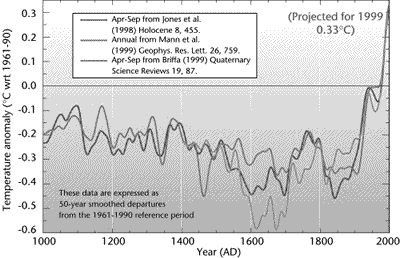 World Temperatures since 1000 AD The corporate climate change criminals • BP Amoco has trumpeted its commitment to reducing its corporate fossil fuel emissions to 10% below 1990 levels by 2010. But it doesn’t include the effects of its products (primarily oil and gas) in this scenario • BP Amoco promises to invest $45 million in its solar power arm, BP Solarex. But 99% of its investments remain in fossil fuels • One of the most destructive of these is the $450 million Northstar undersea oil pipeline project in the Alaskan Arctic Wildlife Refuge • Oil produced by Shell alone emits more CO2 than most countries, including Canada, Brazil and Mexico • ExxonMobil is the seventh largest carbon producer in the world, contributing to 2.69 percent of the world’s carbon emissions • ExxonMobil is a leading supporter and board member of the Global Climate Coalition, which aims to convince Americans that global warming doesn’t exist • In 1997 the oil industry spent $62 million lobbying the US Congress, which still refuses to ratify the Kyoto Protocol • BP Amoco is the largest fossil fuel company in the world, and is responsible for 622 million metric tons of CO2 emitted annually – more than the whole of the UK. For more on this see the excellent ‘Greenhouse Gansgsters vs. Climate Justice’ report by the Transnational Resource and Action Center (TRAC). See www.corpwatch.org/trac/ climate/climatereport.html -for the Web version. See also www.sanebp.com for shareholder organising. Climate change facts • The 1990’s were the warmest decade, and the the 1900’s the warmest century during the last 1000 years [1] • The seven warmest years on record have all occurred within the last decade, with the warmest being 1998 [2] • 1999 will have been the 21st consecutive year with above-average global surface temperatures [3] • Aircraft are the most rapidly increasing source of greenhouse gas emissions, contributing as much as 6% to the warming effect [4] • During 1997 and 1998 Alaska’s Pacific salmon populations plummeted due to starvation induced by exceptionally high sea temperatures [5] • High water temperatures in 1997 and 1998 have also led to unprecedented levels of coral bleaching in all major tropical regions: up to 90% in the Indian Ocean [6] • Diminishing amounts of sea ice in both polar regions are endangering many animal and bird species, including polar bears, penguins and seals [7] • The number of frosty nights recorded in central England has fallen from an average of 47 in the 1960s to 35 today [8]. For an excellent overview of the climate change problem see The Ecologist, Vol 29 No 2 (March/April 1999) References: 1. World Meteorological Organisation press release, 16 December 1999 2. Ibid 3. Ibid 4. Guardian, 21 August 1999 5. WWF/MCBI report: ‘Turning Up the Heat: How Global Warming Threatens Life in the Sea’ 6. Ibid 7. Ibid 8. Observer, 23 January 2000 |