|
|
Magazine Issue 10 - Spring 2000
|
||
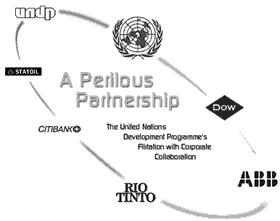 In bed with the UN In bed with the UN In the year since Kofi Annan launched the UN's new Global Compact with transnational business, the world's worst corporate offenders have swarmed to it like bees to a honey pot. John Hilary looks at the UN's hopes of a business-friendly 21st century and the new movement calling for corporate accountability instead. Question: what do Rio Tinto, Nestle, UNOCAL, Dow Chemical, Disney and McDonalds have in common? Answer: their activities offer shining examples of corporate worst practice, and they have all become valued partners of the United Nations over the last year. These companies and many more have leapt at the chance offered by UN Secretary-General Kofi Annan to sign up to the UN's new Global Compact. The Compact is designed to bring transnational corporations into 'partnership' with UN agencies, on the understanding that the UN in AnnanÕs words "helps to expand opportunities for business around the world." Annan floated the idea of the Global Compact at the World Economic Forum in Davos a year ago. Even before its official launch in July 1999 the idea was attracting a host of corporations keen to improve their tarnished images with the stamp of UN approval. 16 corporations including Rio Tinto, Shell, BP Amoco, Novartis, Dow Chemical and ABB engaged in discussions early in 1999 to become the first corporate sponsors of the United Nations Development Programme (UNDP), through US$50,000 donations to its new Global Sustainable Development Facility (GSDF). In return they were offered worldwide access to UNDP contacts and offices and the use of special GSDF logos to show how development-friendly they are. Following international outrage at the proposals, the collaboration has now been put on hold, pending review. The new Business Humanitarian Forum set up last year is co-chaired by the unlikely partnership of Sadako Ogata, UN High Commissioner for Refugees, and John Imle, President of UNOCAL, a company notorious for its use of forced labour in Burma. Also on the Forums board sits Nestle another strange choice, given the company's continued violation of the International Code of Marketing of Breast-milk Substitutes. UNESCO has teamed up with Walt Disney and McDonalds to bring 2,000 'Millennium Dreamers' aged 8-15 to an international celebration of children's achievements to be held at Walt Disney World in Orlando, Florida, in May this year. Disney and McDonalds are funding and managing the initiative, while UNESCO is lending its good name and suggesting criteria for choosing which children will take part. UNESCO has also joined with cosmetics group L'Oral in a five-year partnership to develop Women and Science projects and promote the role of women in scientific research worldwide. L'Oral is part of the Nestle empire, but clearly the "I'm worth it" assurance smoothed over any crisis of conscience which might have troubled UN officials. Potent greenwash It is no coincidence that the multinationals which have responded to the UN's overtures make up a rogues gallery of the worlds worst corporate offenders. The UN association is the most potent greenwash any company could hope for, and those listed above clearly expect it to offset some of the criticism they face. In return, the Global Compact proposed by Kofi Annan required corporations (a) to lobby their governments to give the UN the resources it needs and not to undermine its authority, and (b) to uphold nine key human rights, labour and environmental principles in their operations around the world. Yet these corporations have consistently sought to downgrade the role of the UN in international affairs both individually and through their various industry umbrella groups. Corporate pressure killed the UN's Code of Conduct for Transnational Corporations in the early 1990s, which would have been the first binding set of standards on corporate activities. Instead, transnationals have been tireless in their promotion of the corporate-friendly World Trade Organisation as their preferred institution of global governance over UN bodies such as the UN Conference on Trade and Development. On the second count, transnationals have had to make no adjustments to their operations in order to enjoy the stamp of UN approval. The Global Compact is not binding, and there are no mechanisms for ensuring compliance with Kofi Annan's nine key principles. Instead, the International Chamber of Commerce has launched its own Global Compact website to highlight its links with the UN and to praise its own member companies for their social and environmental initiatives. Citizens Compact At this years World Economic Forum in Davos, 12 months on from Kofi Annan's initial overture to the business community a group of over 50 organisations from North and South launched the Citizens Compact. In sharp contrast to the Global Compact, the Citizens Compact calls for a legal framework of binding rules and independent monitoring to govern corporate activities worldwide. The Citizens Compact notes that the commercial interests of transnational capital threaten the UN's guiding principles of human rights and sustainable development, and calls for all UN dealings with transnational corporations to be subjected to independent scrutiny. And it quotes UNICEF's own Executive Director Carol Bellamy: "It is dangerous to assume that the goals of the private sector are somehow synonymous with those of the United Nations because they most emphatically are not." An excellent source for information on the corporatization of the UN is the Corporate Watch US website at: www.corpwatch.org/globalization/un/. For full text of the Citizen's Compact visit the Corporate Europe Observatory at www.xs4all.nl/~ceo/ Picture: courtesy of Corporate Watch US |